18.12.2025
The retail landscape in 2026 is undergoing a transformation. The “temple of consumption” model that dominated the market in the early 2000s – a large shopping mall focused exclusively on retail – is becoming obsolete. Today, the market is moving in two seemingly contradictory, yet in practice complementary, directions: the transformation of large-scale malls into multifunctional (mixed-use) facilities and the dynamic expansion of local retail parks. What do these changes mean for the design and production of commercial spaces?
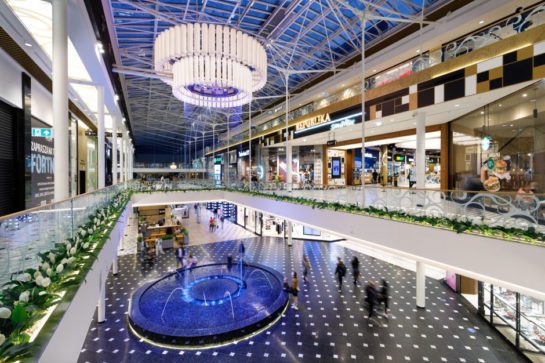
Large shopping centers, particularly those of an older generation, face the need to redefine their role. In a market saturated with retail space and under growing pressure from e-commerce, product sales alone are no longer a sufficient draw for customers.
As a result, we are observing a clear trend toward adapting malls into mixed-use developments. The modern shopping center is becoming a form of a “third place” (after home and work), fulfilling social and city-forming functions. Interiors once dominated by consecutive chain brands are now giving way to coworking zones, medical facilities, gyms, and even public offices or libraries.
From the perspective of commercial space design and production, this represents a significant challenge. In 2026, such spaces must be more flexible and human-centric. This requires, among other things, the creation of relaxation zones and the production of retail furniture that builds a sense of hospitality rather than merely displaying products. Commercial architecture in 2026 will increasingly combine retail, office, and service functions in a seamless and aesthetically coherent way.
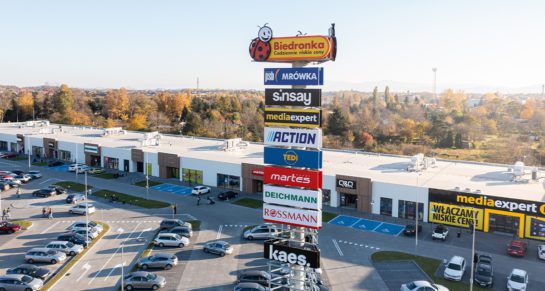
At the opposite end of the spectrum, alongside the transformation of large shopping centers, we are witnessing a boom in smaller formats. Retail parks are currently one of the fastest-growing segments of commercial real estate in Poland.
Located close to large residential areas and in smaller cities, they respond to one of the most important needs of the modern consumer: time efficiency.
Unlike the complex layouts of large malls, retail parks offer simple schemes – direct store access from the parking lot, quick shopping, and straightforward logistics. Grocery discounters, drugstores, and electronics retailers dominate this format. The potential of such locations is recognized, among others, by our client LPP Group. The Tri-City–based company frequently chooses retail parks for Sinsay stores—the fastest-growing brand in its portfolio in terms of new openings—seeking to leverage the opportunities of local markets.
In recent years, we have often been involved in the production of Sinsay stores and other LPP brands in retail parks, both in Poland and across Europe, particularly in the Balkans. In commercial spaces developed in this format, material durability, speed of installation, and modular solutions that can be easily replicated across multiple locations are critical. The layout must be clear and highly functional, directly supporting the concept of “quick shopping.”
The commercial real estate market is not shrinking; it is specializing. Customers expect either “experience and time spent” (multifunctional malls) or “convenience and speed” (retail parks).
At Ergo Store, we closely monitor these changes. Whether we are working on a premium showroom in a revitalized shopping center or fitting out a chain brand in a newly developed retail park, understanding the specific context of the location remains essential. The year 2026 and the years that follow will belong to brands that understand that the concept of a commercial space must follow the consumer’s lifestyle – regardless of the format of the facility.
02.04.2026
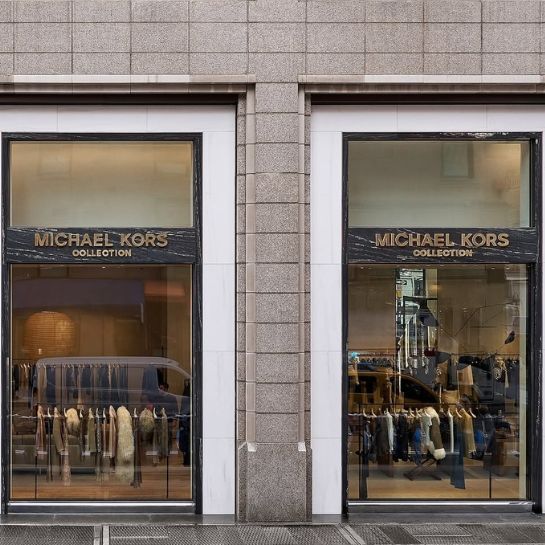
The retail concept of Michael Kors is a journey from an amateur basement boutique to a technologically advanced global retail empire. How has this concept evolved over the years, and what lessons can contemporary commercial space design learn from it?
26.03.2026
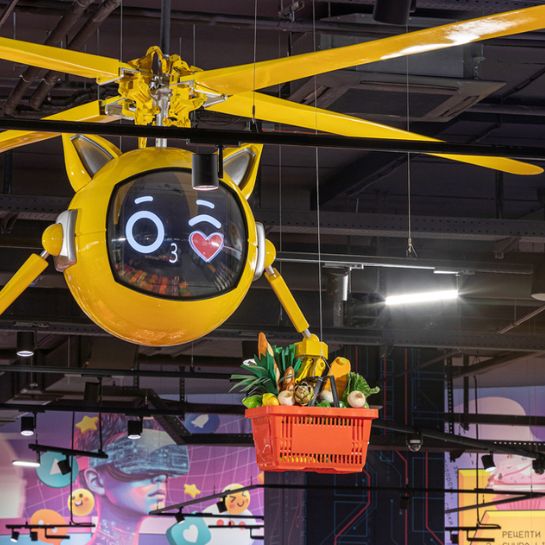
This article presents examples of retail concepts recognized in international competitions such as the EuroShop Retail Design Award, iF Design Award, and Architizer A+Awards, illustrating the direction in which the industry is heading.