07.05.2026
In the era of globalization, it might seem that a universal brand image is the key to success. However, contemporary retail is evolving toward deep localization – the process of adapting operations and customer experiences to the specific needs of a given region. Geographic factors such as climate, architectural heritage, and social habits directly shape the physical form of retail spaces.
In Europe, interior design is an art of balancing heritage preservation with innovation.
The region demonstrates strong demand for adaptive reuse projects — the transformation of historic buildings into modern retail environments while respecting their cultural value. An example of this approach is the Vienna flagship boutique of Hanna Trachten, located in a protected medieval building. Due to strict limitations on structural modifications, designers developed a concept that uses narrow spatial layouts to enhance the shopping experience.

The use of historic buildings is also characteristic of retail projects in other European capitals, including London and Paris. Europe is likewise a leader in implementing circular design principles, particularly in Scandinavian countries. Sustainability regulations encourage store fixture manufacturers to use low-carbon materials and modular constructions that can be easily dismantled and reused.
The North American market is defined by large-scale retail environments and the dominance of car-based mobility, which strongly influences commercial space design.
American consumers favor bulk purchasing and the one-stop shopping model, leading to the development of extremely large retail formats such as Costco and Walmart. These stores require advanced visual navigation systems (wayfinding) and highly legible signage designed for large spatial scales.
Retail aesthetics in North America often reference regional geographic characteristics. In the Southwest, warm earth tones and desert-inspired elements dominate. In contrast, New England design frequently incorporates reclaimed wood, nautical accents, and cooler color palettes.
In store fixture manufacturing, North America relies heavily on ANSI/BIFMA standards, which focus on performance, durability, and load-cycle testing.
Asia is currently the fastest-growing region in retail interior design, driven by rapid urbanization and the expansion of the middle class. Retail spaces — particularly in China and Japan – serve as testing grounds for OMO (Online-Merge-Offline) strategies, where the boundaries between physical and digital retail are almost entirely eliminated.
In China, e-commerce giants such as Alibaba are redefining the role of physical stores through the DMW (Distributed Mini Warehouses) model. These locations function as micro-logistics hubs, enabling fresh product delivery within a 3-kilometer radius in as little as 30 minutes.
Japanese boutiques, including brands like Shiseido and Muji, are designed using advanced data analytics. Technologies such as heat mapping are employed to track customer movement and optimize product placement.

In Australia, extreme climate conditions present a key design challenge. Due to intense solar exposure, designers employ advanced shading systems and ventilated façade solutions that regulate interior temperature and lighting conditions. Retail environments increasingly evolve into integrated retail districts that seamlessly connect with the surrounding landscape.
In Latin America, shopping malls function as contemporary urban plazas, distinguishing them from suburban retail models typical of the United States. They are commonly located in city centers and remain easily accessible to pedestrians and public transport users.
Limited space in densely populated South American cities encourages vertical retail development. Multi-level shopping centers optimize customer flow by placing luxury and fast-fashion brands on lower levels, while financial services, cinemas, and food courts occupy upper floors.
Biophilic design — incorporating daylight, greenery, and water elements — is widely used to create a refuge from urban intensity.

Retail across Africa is rapidly evolving, combining traditional brick-and-mortar commerce with the dynamic growth of digital retail. Design and production solutions emphasize resilience to demanding climatic conditions alongside strong cultural symbolism.
In regions such as South Africa, outdoor and semi-open retail environments must withstand intense UV exposure, strong winds, and coastal air. As a result, store fixtures often utilize powder-coated aluminum, valued for its lightweight and corrosion resistance, as well as exotic hardwoods such as teak, mahogany, iroko, and African walnut, known for natural resistance to decay and insects. Natural fibers are frequently used in upholstery, giving interiors a distinctive local identity.
***
Global success in retail today depends on understanding that a store is not merely a place of transaction, but a dialogue with its local environment.
Nearly 20 years of experience gained by Ergo Store in delivering commercial interiors for brands such as Reserved, Sinsay, Levi’s, Dockers, and More & More enables the company to successfully execute projects that respect geographic and cultural nuances across multiple continents.
24.09.2026
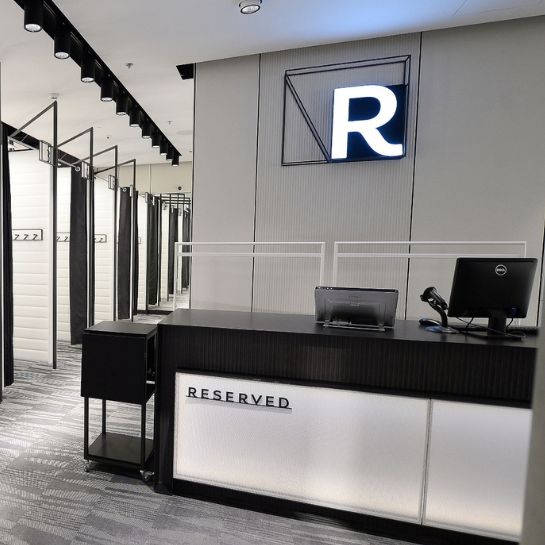
The checkout zone in a brick-and-mortar store is more than just a payment area - it is a critical brand touchpoint and an effective tool for margin generation. Well-designed retail fixtures turn passive queue waiting into an active decision-making process, directly increasing average basket value.