02.04.2026
Tracking the evolution of premium retail concepts, it is difficult to find a more compelling transformation than that of Michael Kors. It is a journey from an amateur basement boutique to a technologically advanced global retail empire. How has this concept evolved over the years, and what lessons can contemporary commercial space design learn from it?
The beginnings of Michael Kors date back to 1970 and the “Iron Butterfly” boutique, located in the basement of a house on Long Island, New York, owned by Kors’s parents. Although amateur in nature, the initiative marked the designer’s first step toward direct customer interaction and building a narrative around collections within a defined physical space.
A pivotal moment in Kors’s development came in 1978 when he began working at the Lothar’s boutique on West 57th Street in Manhattan. There, he served not only as a salesperson but primarily as a designer and visual merchandising lead. It was at Lothar’s that his talent for creating eye-catching window displays and interior arrangements was noticed by Dawn Mello, then Vice President of Bergdorf Goodman. This recognition directly led to the debut of his own collection at the prestigious department store in 1981.
Through his experience at Lothar’s, the designer realized that luxury must be communicated not only through fabric quality but through a carefully orchestrated environment that makes customers feel confident, relaxed, and indulged.
One of the key factors behind Michael Kors’s success is the precise segmentation of its product offering, clearly reflected in interior design strategies and retail equipment selection.
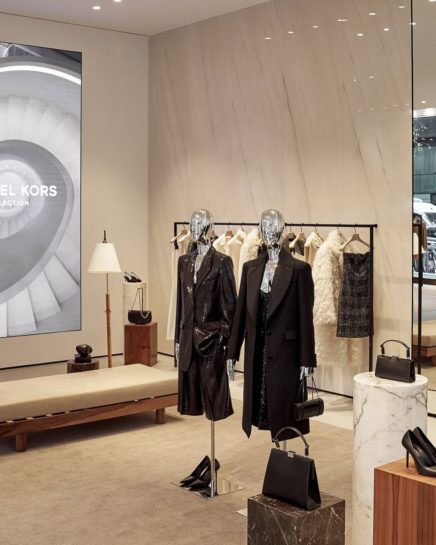
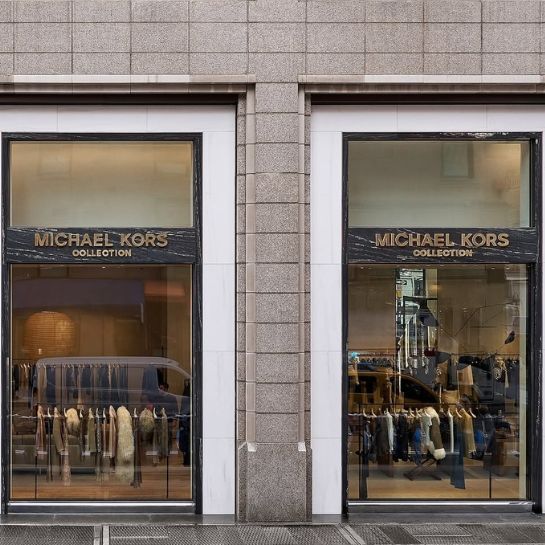
Boutiques dedicated to the runway line are designed as calm sanctuaries contrasting with the fast pace of urban life. Over time, the concept evolved toward a “luxury private residence” aesthetic characterized by high ceilings and sculptural forms. The boutique at 667 Madison Avenue, for example, features materials such as blackened steel, raw concrete, antique brass, and oxidized maple, creating a neutral yet richly textured palette.
MICHAEL Michael Kors stores – often described as lifestyle environments—are designed to radiate energy and glamour. The recognizable “Jet Set” aesthetic is expressed through glossy surfaces, mirrors, metallic finishes, and large-format photography. These stores focus primarily on accessories, the core of the brand’s business model, and frequently incorporate the repeating MK logo motif into the interior design.
The third pillar consists of outlet locations offering dedicated Made-for-Outlet products within a more utilitarian environment. While maintaining the brand’s visual codes, finishing materials are more durable and layouts are optimized for high customer turnover and price-driven merchandising.
Michael Kors retail strategy extends far beyond permanent stores, embracing bold creative concepts that redefine modern visual merchandising.
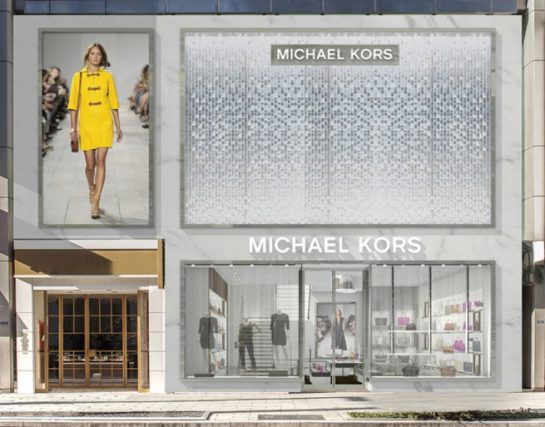
Opened in November 2015, the Ginza flagship was the first store worldwide to present the designer’s full product universe under one roof.
The exterior architecture reflects Kors’s affinity for metallic textures. The façade is composed of shimmering screens made from reflective facets set within a grid of internally illuminated recesses, evoking the sparkle of a sequined dress. Inside, references to local culture appear through rice-paper accents and Macassar wood display boxes, merging American lifestyle aesthetics with Japanese minimalism and refinement.
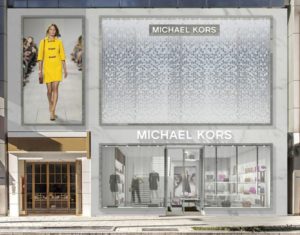
Fot. fashion-headline.com
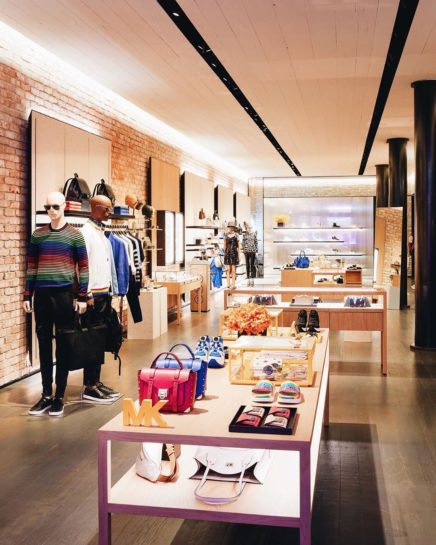
Opened in 2019 at 90 Prince Street, this monumental boutique introduced an “urban loft” concept inspired by SoHo’s artistic heritage. The original cast-iron façade was preserved, while exposed brick walls and rustic wooden flooring define the interior. The most distinctive architectural feature is a mirrored waterfall installation at the back of the store, designed to display footwear while creating dynamic reflections and light effects.
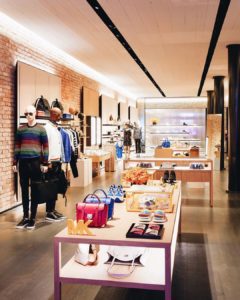
Fot. windowswear.com
Wnętrze butiku przy 667 Madison Avenue przypomina galerię sztuki. Znajduje się tu modernistyczna instalacja mobilna autorstwa brooklyńskiego artysty Maxa Simona oraz ogromna lampa Noguchi. Koncept stawia na przemyślaną, selektywną ekspozycję sprzyjającą spokojnemu odkrywaniu kolekcji.
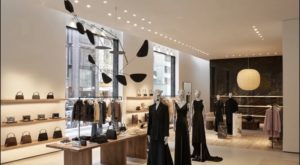
Fot. Michael Kors
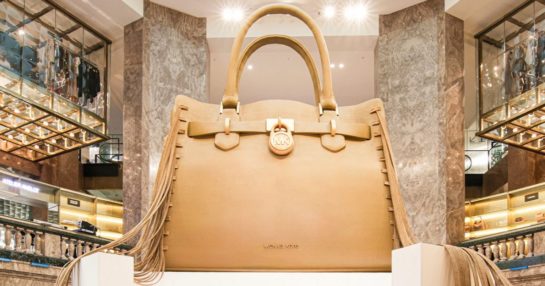
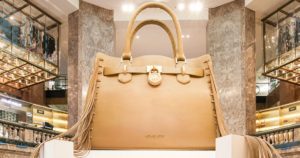
One of the brand’s most spectacular creative expressions was the installation at Galeries Lafayette Champs-Élysées in Paris, unveiled in September 2025 to celebrate the new edition of the iconic Hamilton handbag. A 4.5-meter-high sculpture of the Hamilton Moderne bag, decorated with long fringes, dominated the atrium space.
Visitors entered through a tunnel lined with campaign visuals before “checking in” at a desk resembling the reception of a vintage luxury hotel. The pop-up offered more than retail: champagne evenings, a live-music bar, and a dedicated accessory personalization zone transformed the installation into a full experiential environment.
fot. galerieslafayette.com
Today, Michael Kors is a leader in phygital retail solutions—seamlessly merging physical and digital experiences. In flagship locations such as Shanghai and London, the brand experimented with Smart Mirror technology: interactive fitting-room mirrors allowing customers to adjust lighting conditions, browse alternative colors and sizes, and request assistance directly from staff.
In June 2024, the brand introduced Shopping Muse, a generative-AI-powered shopping assistant capable of translating conversational requests—such as “I’m looking for shoes for a summer garden wedding”—into tailored product recommendations based on customer preferences and prior shopping behavior.
The evolution of Michael Kors stores also reflects a broader transformation toward environmental responsibility. The Kors Loves initiative establishes operational standards for all new and refurbished locations. By the end of 2023, the brand achieved 70% renewable energy usage across its directly operated global activities, including retail stores.
Today, 99% of in-store packaging—boxes and shopping bags – is recyclable or sourced from sustainable materials. New store concepts prioritize lower-impact materials, while durability of store fixtures is emphasized to reduce renovation frequency and construction waste.
The evolution of Michael Kors retail spaces demonstrates that the physical store has become a dynamic organism—flexible, emotionally engaging, and fully integrated with the digital ecosystem.
At Ergo Store, drawing on nearly 20 years of experience in producing retail environments for market leaders, we understand how to translate global trends into practical production solutions.
Want to align your store equipment with your brand architecture? Contact the Ergo Store specialists.
26.03.2026
This article presents examples of retail concepts recognized in international competitions such as the EuroShop Retail Design Award, iF Design Award, and Architizer A+Awards, illustrating the direction in which the industry is heading.
19.03.2026
In one of our previous articles, we outlined the general principles of the circular economy in retail. This time, we focus on circular shopfitting - how these principles translate into specific structural, material, and technological solutions in the production of retail furniture.