14.05.2026
The evolution of retail spaces in the fashion industry over the last four decades reflects the social, technological, and economic transformations that have shaped the modern world. Fashion stores have ceased to function merely as physical points of product distribution, becoming instead multidimensional platforms for brand communication.
At Ergo Store, we have been manufacturing stores for leading fashion brands for nearly 20 years, giving us the opportunity to observe how both brand requirements and consumer expectations continue to evolve.
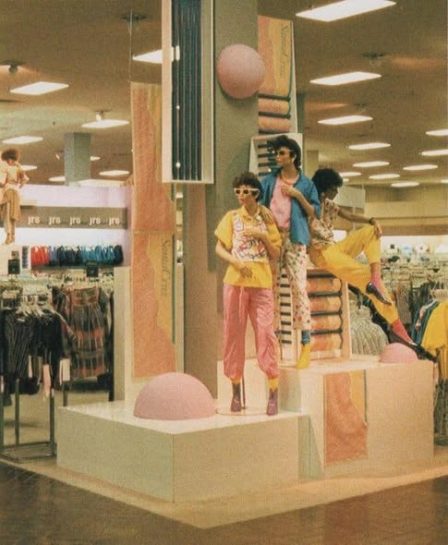
The 1980s were defined by economic optimism and the rapid rise of consumerism. Stores of that era were designed as “temples of success.” Power dressing dominated fashion, while retail interiors were intended to reflect social status and ambition.
It was the era of monumental department stores and the expansion of enclosed shopping malls. Interior architecture embraced excess — intense lighting, mirrors, gold accents, and monumental displays overwhelmed customers with a sense of abundance. The store was a place where the product itself was the focal point, and physical product availability was considered the retailer’s greatest advantage.
Visual merchandising concepts focused on maximizing sales floor space. Large, immediately available assortments were believed to be essential for building customer trust. Spatial layouts often relied on narrow aisles and tall shelving systems, forcing customers to interact with a large number of products as they moved through the store.
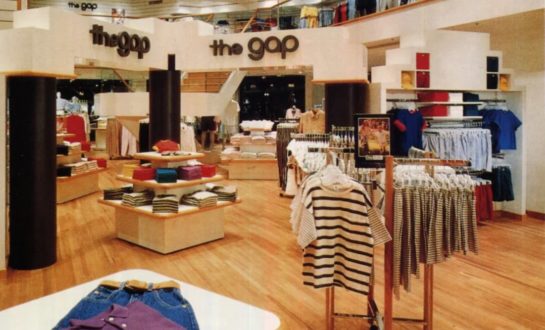
The following decade brought a shift toward the “less is more” aesthetic. The 1990s saw growing fatigue with ostentation, leading to the rise of minimalism. Retail interiors became more raw and gallery-like, frequently incorporating concrete, steel, and glass.
One of the global leaders of this approach was GAP, whose stores stood out for their spaciousness and strong focus on customer comfort and product clarity.
An important phenomenon of the period was the rise of flagship stores. These spaces evolved beyond purely sales-driven functions and became powerful tools for building brand image and identity. It was during this time that retail began to be viewed as a strategic marketing instrument rather than solely an operational necessity. At the same time, the first signs of the digital revolution began to emerge, although e-commerce was still in its infancy.
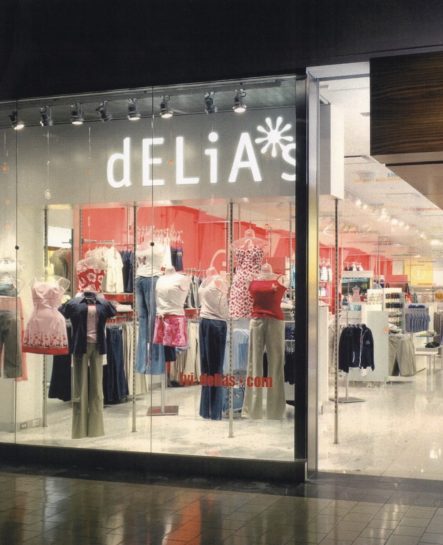
The beginning of the new millennium marked the dominance of brands such as Zara (part of Inditex) and H&M. These companies redefined the “fast fashion” model, delivering trend-driven clothing inspired by the latest runway styles at high speed and affordable prices, fundamentally transforming the operational dynamics of fashion retail.
After 2010, physical retail had to respond to the growing power of the internet. Stores gradually evolved into “experience ecosystems.” Interactive mirrors, digital kiosks, and click-and-collect systems became increasingly common. The boundary between offline and online retail began to blur, giving rise to omnichannel strategies adopted by brands such as Burberry, Nike, and John Lewis.
Contemporary retail is increasingly shaped by responses to climate and social challenges. Today’s stores are designed to communicate ethical values as much as commercial offerings.
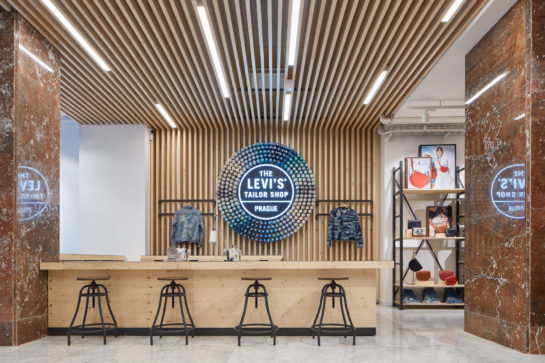
An excellent example of this evolution is Levi’s. Our long-term client, for whom we have delivered projects across nearly all of Europe, continues to set standards in combining heritage with innovation. Within the brand’s retail concepts, Tailor Shops — dedicated spaces for clothing personalization and repair – now play an increasingly important role. One such space can be found in the Levi’s store in Prague manufactured by our company, currently the largest Levi’s store in Central and Eastern Europe.
This “repair and rewear” approach aligns with the principles of the circular economy, where retail furniture must not only showcase products but also provide functional spaces for craftsmanship and repair services. Meanwhile, Patagonia promotes garment repair through its “Worn Wear” program, featuring dedicated repair stations inside stores while educating customers on how to extend the lifespan of their clothing for decades.
The evolution of fashion retail concepts from the 1980s to today represents a transition from “temples of merchandise” to “experience centers.” At Ergo Store, we have collaborated with global industry leaders for nearly two decades, and today we are witnessing a renaissance of brick-and-mortar retail – one that is becoming increasingly intelligent, flexible, and ethically driven.
Our role is to deliver retail furniture solutions that not only keep pace with change, but actively help shape it, providing our clients with a competitive advantage in an increasingly demanding market.

09.07.2026
The Balkans remain a constant and highly active destination for our projects carried out for the LPP Group. In the spring of 2026, our team completed another production in the region: a new Sinsay store in the city of Gjakova, Kosovo.